Philosophy Discussion
I host a philosophy discussion on the 3rd Sunday of each month at 1:30 pm. We meet at Yoga From the Heart at in Laconia and participation is free.
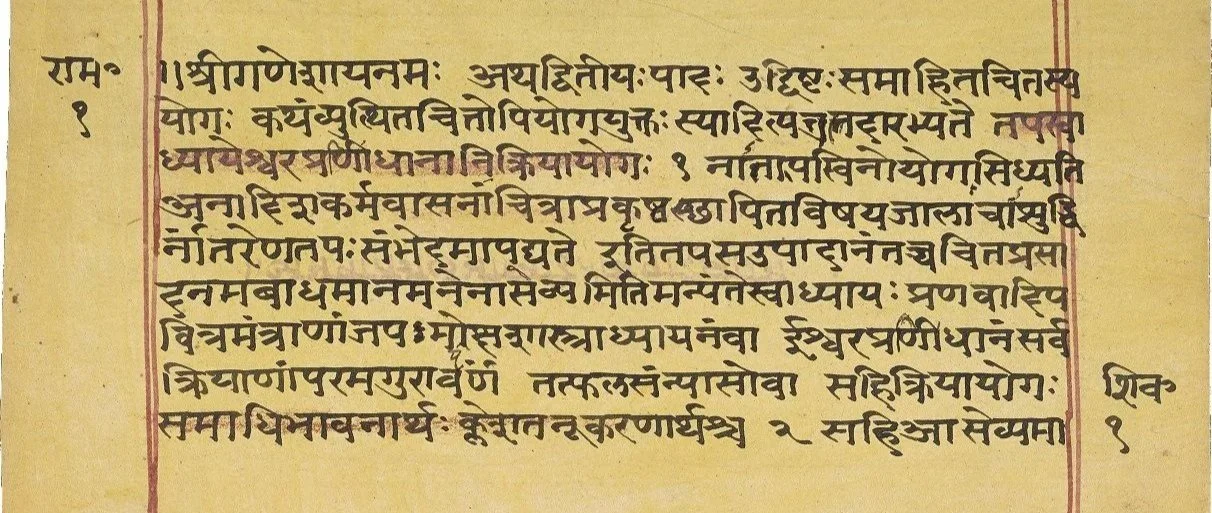
The discussion is open to anyone interested in studying Indian philosophy and spirituality, whether or not they have a physical yoga practice. Our focus is on reading and discussing classical texts such as the Yoga Sutras of Patanjali and the Bhagavad Gita.
I maintain an email list to which I send out a summary after each discussion and a reminder before the next discussion. You can use the form below if you would like to be added to the email list.
Below, you can find summaries of past discussions as well as a list of resouces (books, webistes, etc.).
Summary of March 15th Discussion
We continued our discussion of the first 16 sutras of the Yoga Sutras of Patanjali. These sutras establish some of the fundamental concepts of Patanjali's yoga philosophy.
An Overview of Sutras 1.1-16
Sutras 1.1-4 - define yoga as the stilling (nirodha) of the changing states (vrittis) of the mind (chitta) and describe what happens when this is done (the soul abides in its true nature)
Sutras 1.5-11 - catalog and describe the five different types of vrittis, or changing states of mind
Sutras 1.12-16 - explain the means by which the changing states of mind are stilled, namely practice (abhyasa) and renunciation/non-attachment (vairagya)
The Five Vrittis
The yoga sutras present a systematic organization of all mind states into five types:
Pramana - right knowledge - knowledge about things in the world that is correct (knowing that you parked on Canal St)
Viparyaya - error - knowledge about things in the world that is incorrect (thinking you parked on Canal St when you actually parked on Main St)
Vikalpa - imagination, fancy - mind states based on things that lack a basis in material reality (fictional stories, dreams, etc.)
Nidra - deep sleep - the state of deep sleep is interesting because in it the mind is marked by an absence of content, but it is clearly distinct from the meditative state of samadhi, where the mind is empty/still
Smrti - memory - mind states based on recall of previous mind states
During our discussion of these sutras, we discussed how not every sutra is meant to be inspirational, or offer wisdom about how to live. Some sutras function only to lay out a systematic philosophical framework. Sutras 1.5-11 are an example of this. In the next sutras, however, Patanjali does offer wisdom about how to live, specifically instruction on how to still the mind.
Abhyasa and Vairagya
Sutra 1.12 abhyāsa-vairāgyābhyāṃ tan-nirodhaḥ
[The vritti states of mind] are stilled by practice and renunciation/non-attachment
While sutra 1.2 defines yoga, sutra 1.12 gives us a formula for how it is practiced. Patanjali's most well-known formulation of yoga involves eight limbs, but here there are just two components: abhyasa (practice) and renunciation/non-attachment (vairagya). This same formulation is given by Krishna to Arjuna in Chapter 6 of the Bhagavad Gita.
Sutra 1.13 tatra sthitau yatno-'bhyāsaḥ
Of these, practice is the effort to be fixed in concentrating the mind
In this sutra, Patanjali tells us that the path of yoga is not an easy one. Learning to control the mind will require great effort on our part. As Arjuna says to Krishna, "the mind is unstable, turbulent, powerful and obstinate. I think it is as difficult to control as the wind." (Bhagavad Gita, 6.34)
Sutra 1.14 sa tu dīrgha-kāla-nairantarya-satkāra-āsevito dr̥ḍha-bhūmiḥ
Practice becomes firmly established when it is continued for a long time, without interruption, and with devotion
Here Patanjali offers us a method for taking on the difficult task of abhyasa. To successfully learn to control the mind through effort, we must be steadfast, we must have great endurance, and we must approach this great effort from a place of great devotion.
Another thing we discussed were different recommended translations. At the bottom of this email, I list some of my favorites. One version that is not listed there but that we discussed was Bernard Bouanchaud's The Essence of Yoga: Reflections on the Yoga Sutras of Patanjali. This is an interesting translation which includes a word-for-word Sanskrit translation and an English translation, but then in lieu of an author's commentary gives study questions and themes for reflection.
Summary of February 15th Discussion
We started by talking about the principal ancient souce texts on yoga, the Bhagavad Gita and the Yoga Sutras of Patanjali. The Gita is a more complex work, covering several different types of yoga, and several strands of Indian philosophy, while the Yoga Sutras are a more straightforward treatise on mental discipline undertaken for the purpose of liberation.
Sutra literature from this era is found across Indian philosophical traditions. Sutra means thread, and refers to both the complete works and the short aphorisms of which they are composed, perhaps because they were originally transmitted orally. The sutras are dense with meaning, difficult to decipher or translate. On top of the original sutras, there is a tradition of written commentaries which elaborate on them. Typically, there is an early commentary that is considered definitive. In the case of the Yoga Sutras, this is the commentary of Vyasa.
We then proceeded to read the first few Sutras of the first chapter, or Pada, of the Yoga Sutras, the Samadhi Pada. Samadhi can be translated as "meditative absorption."
In the sutra text below, I'll first provide the Sanskrit, written in IAST, the International Alphabet of Sanskrit Transliteration (you can find a pronunciation guide here), and then I'll provide Edwin Bryant's English translation. Note that every translation is an interpretation, and we shouldn't treat any one translation as definitive.
Sutra 1.1 atha yogānuśāsanam
Now, the teachings of yoga
This is a fairly straightforward sutra, but the commentaries on it can be lengthy, as this is where the commentators introduce the subject of their discourse. We discussed the classification of 5 states of mind from Vyasa's commentary:
Ksipta - wandering, distracted
Mudha - dull, sluggish
Viksipta - at times concentrated, at times distracted
Ekagra - one-pointed
Niruddha - restrained
In the last three of these states, yoga is possible.
Sutra 1.2 yogaś cittavṛtti nirodhaḥ
Yoga is the stilling of the changing states of mind
This is a critical sutra as it defines the technique of yoga. Normally the mind is in a constant state of flux, moving from thought to thought. Yoga is the restraint of this movement.
We talked about the meaning of citta (pronounced "chitta"). The yoga sutras follow the metaphysics of the Samkhya philosophical system, which divides everything that is into two categories: Prakriti and Purusha:
Prakriti includes the physical world, but also the mental faculties. It is changing and lacks unconsciousness.
Purusha is unchanging and conscious. Our soul is purusha, and this is our true self.
Chitta is an umbrella term for the mental faculties. In the Samkhya system, it is further broken down into:
Buddhi - intelligence, discrimination, discernment
Ahamkara - the sense of "I am"-ness
Manas - mental faculties such as the senses, desires, aversions
Sutra 1.3 tadā draṣṭuḥ svarūpe avasthānam
When that is accomplished, the seer abides in its own true nature
Patanjali uses the term drastr, "the seer," to refer to our true, purusha self. This is in contrast to drsya, "the seen," our mental faculties. The fundamental problem which yoga seeks to remedy is the mis-identification of the mental faculties as the true self. By stilling the mind, yoga allows the true self to see itself as it truly is. This is samadhi.
We talked about whether this is an all-or-nothing thing, or whether one can have glimpses of samadhi. I firmly believe that we can have glimpses. For most of us our mind is in the viksipta state: at times concentrated, at times distracted. And in this state yoga is possible. We can still the mind (even if ever-so-briefly), and for that brief moment, we can abide in our true nature.
Resources
There are many published translations of the Yoga Sutras of Patanjali available. Here are a few recommendations:
The Yoga Sutras of Patañjali: A New Edition, Translation, and Commentary by Edwin Bryant - a very good translation, the commentary can be a bit lengthy and academic
Light on the Yoga Sutras of Patanjali by B.K.S. Iyengar - the translation and commentary focus on making the sutras accessible and bringing them to life for the practitioner
Yoga Philosophy of Patanjali by Swami Hariharananda Aranya - the translation is a little less accessible, but the book also includes a translation of the commentary of Vyasa
Exploring the Yoga Sutras by Nicholas Sutton - similarly academic in approach but more readable than Edwin Bryant, draws numerous parallels to the Bhagavad Gita
The Yoga Sūtras of Patañjali: A Collection of Translations by Popsi Narasimhan - an interesting book compiled by a friend of mine, includes several different translations without commentary
There are also some very good free Yoga Sutra resources:
Yoga Sutra Study - an good resource with a collection of different translations
SwamiJ.com - an in-depth, sutra-by-sutra explanation/commentary
Wisdom Libary - translations of the original text, the commentary of Vyasa, and the later commentary of Vachaspati Mishra
My freind Popsi also has posted a very well done video of the Yoga Sutras being chanted in Sanskrit on YouTube.